
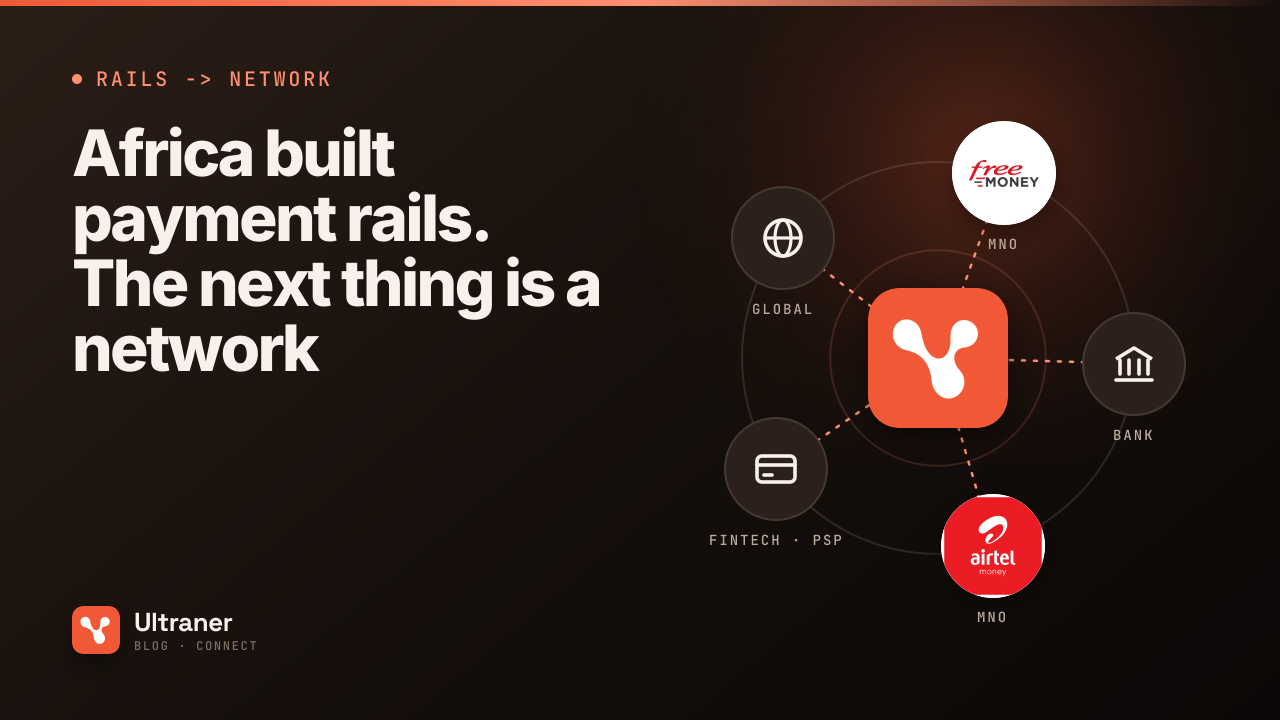
A rail is a road. A network is the highway code.
Africa has built some of the most successful payment rails in the world. Each mobile money service is a rail: accounts, balances, a way to move value from one to another, all inside one system. GSMA's reports track how much moves on them, around $1.4 trillion across Africa in 2025 3. Banks run their own rails. National switches run others.
What is still scarce is the layer above: shared rules for moving money between rails, across operators, currencies and borders, that any participant can follow without a private deal with every other one.
Rails and networks are different things
The words get used interchangeably. They should not be.
A rail moves money between accounts it controls. It knows its own customers, its own ledger, its own limits. M-Pesa in Kenya is a rail. A bank's internal transfer system is a rail. A rail is excellent at what happens inside it and has no opinion about what happens outside it.
A network defines how independent rails talk to each other. It owns no customer accounts. It owns the rules: how to address someone on another rail, what a payment message means, who is allowed to send one, how a disagreement is resolved, and how the institutions settle up afterwards.
Card schemes are the most familiar example of the difference. A card network does not hold anyone's money. Banks do. The network sets the message formats, the authorisation flow, the dispute rules and the settlement process that let any card from any issuer be accepted by any acquirer. That is an architectural analogy, nothing more: it shows what a network layer is for.
What the gateway era got right, and where it stops
The last decade's answer to fragmentation was the gateway or aggregator. Integrate once with an aggregator; the aggregator integrates with many rails.
Gateways solve a merchant's problem well. Ultraner's own merchant product works this way: merchant -> Ultraner -> gateway -> rail. A business integrates one API and collects from mobile money in 14 markets.
But a gateway is a hub, not a protocol. Its connections are private. The participants on each side cannot see or use each other's connections, only the gateway's. Two operators connected to the same aggregator still cannot pay each other through it unless the aggregator builds that product. And the rules (states, errors, timeouts, settlement) are whatever the aggregator's code happens to do.
A gateway is a hub you plug into. A network is a set of rules you agree to.
What a network adds
The shape changes from merchant -> gateway -> rail to Network A -> network -> Network B. To make that work, five things move from private implementation to public contract:
- Identity. Participants are first-class entities with their own credentials and a directory entry, not merchant accounts in disguise.
- Addressing. Any participant can resolve a payment address to an identity, a country, a currency and the rails that reach it.
- Messages. A fixed set of message types (resolve, quote, authorize, execute, status, reverse, refund, callback) with defined meanings.
- State. One transaction state machine, one-directional, with explicit failure states and maximum dwell times, and a network reference distinct from each participant's own.
- Settlement. Obligations recorded at completion, netted in windows, reconciled before they are marked settled.
The BIS cross-border roadmap points at the same missing pieces at global scale: common message standards, interlinked systems, better data and clearer rules for access 1. The industry's move to structured messaging such as ISO 20022 2 is part of the same shift. Rails are being asked to speak a common language.
Why now
Three things make this the right moment in Africa specifically.
The rails are mature. Mobile money is no longer a pilot. Operators have the scale, the risk teams and the regulatory relationships to participate in something larger.
Regional settlement infrastructure is arriving. PAPSS was set up to let payments between African countries settle in local currencies 4. Settlement infrastructure is necessary, but participants still need a messaging, routing and obligation layer to decide what to settle.
Cross-border demand is real and badly served. Trade, remittances, gig work, and global companies wanting to collect from African customers all push money across rails that were built to be self-contained.
What we are building, and what we are not
Ultraner Network is a separate product from Ultraner's merchant gateway. It is designed as a participant protocol: the protocol page is the specification, and the network overview shows the architecture.
What exists: participant identity and credentials, the directory, quotes, a routing engine that ranks candidates (availability, liquidity, fees, FX, limits, compliance, risk, reliability, speed, preference) separately from the policy that picks one, the transaction state machine, settlement windows with netting and a reconciliation gate, a certification suite, and a participant portal. It runs in sandbox against simulated participants.
What does not exist yet: live participants, real money moving between participants' banks, and a production compliance and risk engine. Real connectors to operators and banks come as adapters behind a provider-neutral interface, after the core is proven, not as the thing the core is shaped around.
We say this plainly because a network's first asset is credibility. A participant deciding whether to connect deserves to know exactly what is running.
What this means if you run a rail
If you operate a wallet, a bank's payment system, or a PSP:
- Your rail stays yours. Your customers, ledger, pricing and product remain your own.
- You expose a small, defined interface to the network instead of negotiating private links.
- Every other participant becomes reachable through that one interface, and you become reachable by them.
- Your settlement position across all of them arrives as one reconciled set of obligations per currency.
The question for your strategy team is not "should we build more links?" It is "which rules would we accept, if every other rail accepted them too?" Read the protocol, then see what joining involves on connect.