Ask a shop owner in Dakar how their customers pay and you will rarely get one answer. You will get a list, said quickly, as if it were obvious: Wave, Orange Money, sometimes Free Money, cash for the rest.
That list is the most useful thing to understand before you sell online in Senegal. It is a market where more than one wallet matters, where customers often hold more than one, and where a competitor cutting prices reset what people expect a transfer to cost. If your checkout offers only one of those wallets, or worse only a card, you are telling a good share of Senegalese buyers that you did not build for them.
The three wallets, and why each one is there
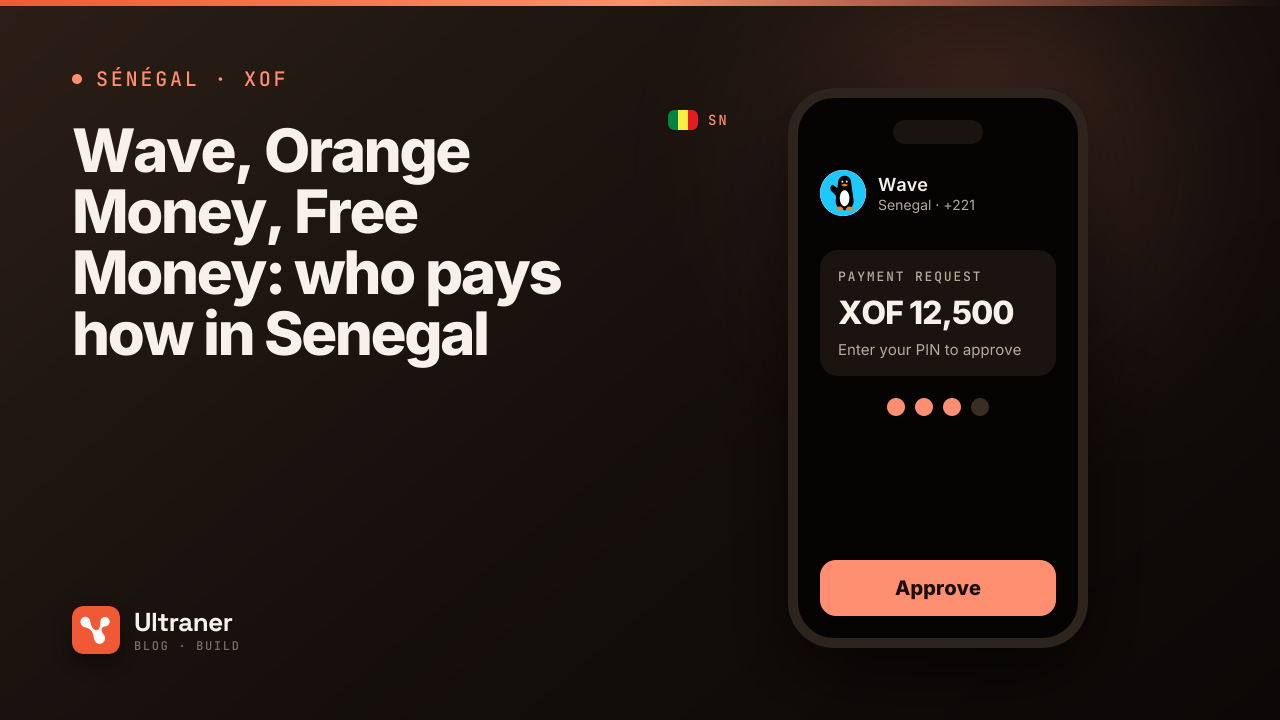
Wave. Wave started in Senegal, and its pitch was price. It charged far less than incumbents for sending money, and in doing so changed what Senegalese users think a transfer should cost. The GSMA's industry reporting has followed how low-fee entrants reshaped West African mobile money 1. For you, the practical consequence is behavioural: many Senegalese customers, especially younger urban ones, reach for Wave first.
Orange Money. The incumbent of Francophone West Africa. Orange Money has deep agent networks, long habits and a large base of users who have had their wallet for years. In Senegal it is still the one many families, small traders and older customers use.
Free Money. Run by Senegal's third mobile operator, which has since rebranded its consumer business as Yas. You will see both names on customers' phones. Smaller than the other two, but present, and for its users it is the wallet.
All three are in Ultraner's Senegal checkout. Each has its own page if you want the detail: Wave, Orange Money and Free Money. Which of them are switched on for your account at any given time comes from GET /v5/providers, and that is what your network picker should be built from, not a list typed into your frontend.
The money is XOF, and it has no cents
Senegal uses the West African CFA franc, XOF, shared by the eight member states of the West African monetary union and issued by the BCEAO 2. ISO 4217 gives XOF zero decimal places 4. There are no cents. There never were.
So when you send an amount to the API, it is the whole number of francs:
| Customer pays | You send |
|---|---|
| 2,500 FCFA | 2500 |
| 15,000 FCFA | 15000 |
| 120,000 FCFA | 120000 |
If your code was written for euros or dollars and multiplies everything by 100, a 15,000 FCFA order becomes a 1,500,000 FCFA prompt. The customer declines it, correctly, and probably does not come back. The XOF currency page carries the same rule, and we wrote a whole piece on why XOF and XAF break code that assumes cents.
The useful side effect: because XOF is shared across the union, a price list you build for Senegal reads naturally in Ivory Coast and Benin as well, which are also live Ultraner markets.
Numbers start with 221
Senegalese mobile numbers are nine digits after the 221 country code, twelve in total. Customers will type them as 77 123 45 67, +221 77 123 45 67 or 771234567. Normalise to digits only with the country code: 221771234567.
Do not infer the wallet from the number alone. A customer with an Orange line may well pay with Wave, because Wave is an app on the phone, not a SIM. That is the biggest single difference from East Africa, where the wallet and the SIM usually go together. Ask, and remember the answer for next time.
What the checkout should look like
For a Senegalese phone number, a good checkout shows:
- A phone field that accepts any of the common formats and cleans it up.
- Three wallet buttons, with logos the customer recognises, in the order your own customers use them. If you do not know yet, start with Wave and Orange Money side by side.
- A clear "approve on your phone" waiting state, in French.
- Card and PayPal as secondary options for the diaspora buyer in Paris or Montreal paying for something at home.
That last point matters in Senegal more than in many markets. A meaningful share of purchases for Senegalese households are paid by relatives abroad. A card processed through Stripe or a PayPal payment handles them, and the same checkout session can offer all of it.
To try it without code, a payment link gives you a hosted page with every method the payer can use. For a full integration, the universal charge endpoint takes the network as the provider field:
POST /v5/payments/express/mno
{ "msisdn": "221771234567", "amount": 15000, "currency": "XOF",
  "country": "SN", "provider": "Wave" }
The response means "request accepted". The real result comes on your webhook as payment.success or payment.failed.
Language is a payment feature
Senegal's commercial language online is French, and a lot of everyday conversation happens in Wolof. A checkout that says "Payment pending" in English loses people at the moment they need reassurance. At minimum, write your waiting and failure messages in French: "Validez le paiement sur votre téléphone", "Le paiement n'a pas abouti, réessayez". Have a native speaker read them. Small copy errors at checkout read as a sign of a scam.
Fees and who pays them
Network charges across most of West Africa sit around 2% on the mobile money rail Ultraner uses for these markets, on top of the rail's own 1%. Pull a real quote for your typical basket before you set prices, then decide whether to absorb it or gross it up. A 2,500 FCFA item and a 120,000 FCFA item do not have the same tolerance for a visible fee.
Your collected XOF sits in your balance and settles to your own bank account in any country. Wallet payouts into Senegalese wallets are not live yet (Tanzania is the live wallet payout market today), so if your model pays local suppliers or drivers, plan on settlement and onward payment for now. The Senegal payments page shows the current state.
A short list for the team
- Offer Wave, Orange Money and Free Money, built from the live provider list.
- Send XOF as whole francs. No multiplying by 100, anywhere.
- Normalise
221numbers, and ask for the wallet rather than guessing it. - Write the checkout in French, reviewed by a native speaker.
- Keep card and PayPal for buyers abroad.
The World Bank's Findex shows account ownership across West Africa rising on the back of mobile money 3. In Senegal that growth has not consolidated into one wallet, and there is no reason to expect it will soon. Build for the list, not for the leader.