
Yes. A company based anywhere can be paid by customers using M-Pesa in Kenya. But the question hides three different questions, and the answer to each is slightly different.
- Can my Kenyan customer pay me with M-Pesa? Yes.
- Can a customer outside Kenya pay me with M-Pesa? Only if they hold a Kenyan M-Pesa wallet. M-Pesa is a domestic system.
- Can I receive the money in my bank account abroad? Yes, by settlement to a bank account, which works in every country.
Here is each one, precisely.
1. Your customer is in Kenya, you are not
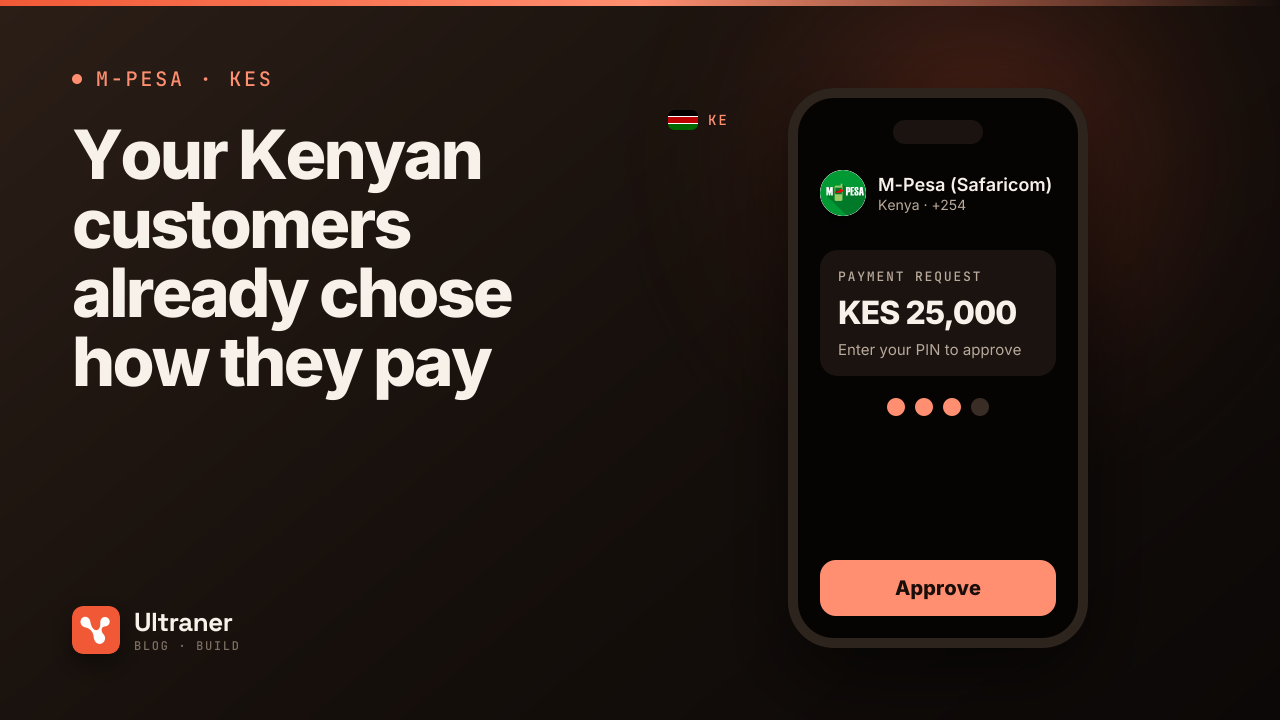
This is the common case. A Kenyan buyer, a business in London. The buyer pays from their M-Pesa (Safaricom) wallet, in Kenyan shillings, by approving a prompt on their phone. They never see a foreign checkout, never enter a card, never think about exchange rates.
What happens on your side:
- Your checkout (or your server, through the API) asks Ultraner to charge the customer's Kenyan number.
- Ultraner reads the country from the +254 prefix and routes to the Kenyan rail.
- The customer approves with their M-Pesa PIN.
- Your Ultraner balance is credited in KES, and you get a webhook.
You are not a Kenyan company and you do not need a Kenyan bank account for this flow. Ultraner holds the connection to the rail; you hold an Ultraner account. Like any payments provider, we verify the business before it goes live.
M-Pesa is the dominant mobile payments system in Kenya, and the Central Bank of Kenya publishes its monthly mobile payments data publicly 1. If your customers are Kenyan consumers or small businesses, this is how many of them would choose to pay.
2. The payer is outside Kenya
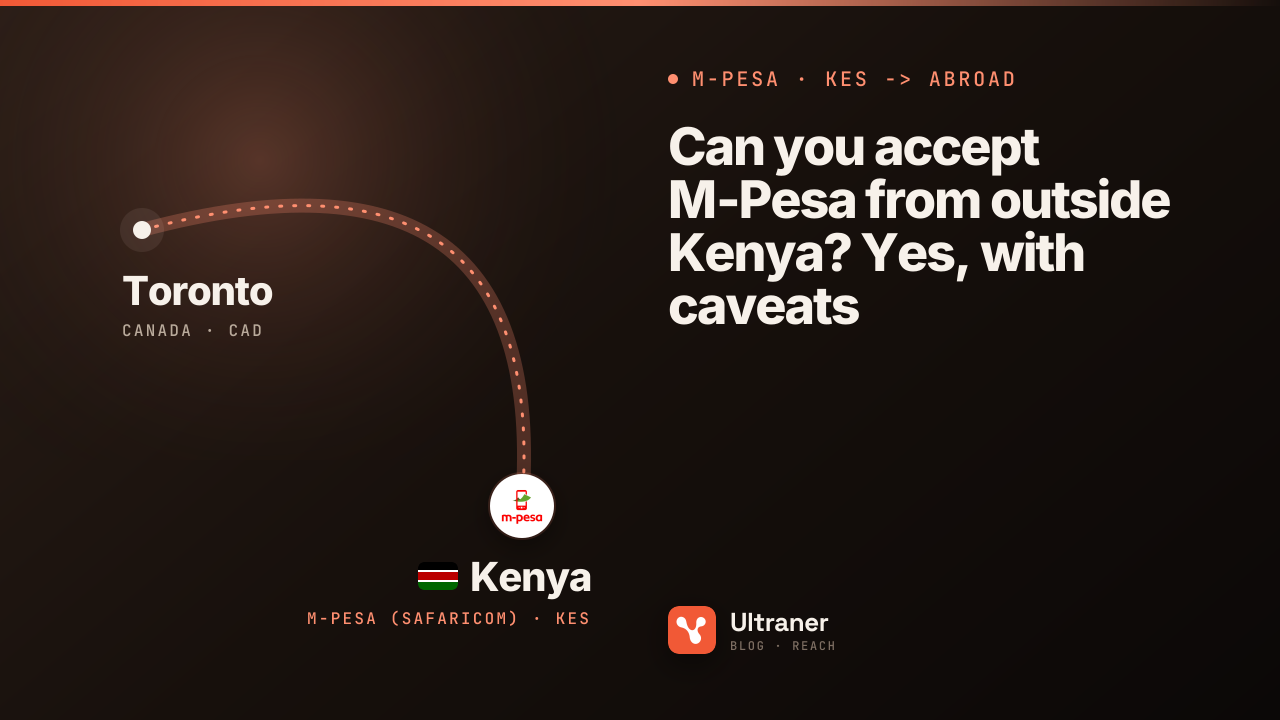
Here the answer narrows. M-Pesa in Kenya is a Kenyan system: a Kenyan SIM, a Kenyan wallet, Kenyan shillings. A Kenyan living in Toronto may still have an active Kenyan M-Pesa wallet and can pay from it, because the wallet is still Kenyan. A Canadian without one cannot.
There is also a naming trap. "M-Pesa" is used by different operators in different countries:
- In Kenya, M-Pesa is run by Safaricom, in KES.
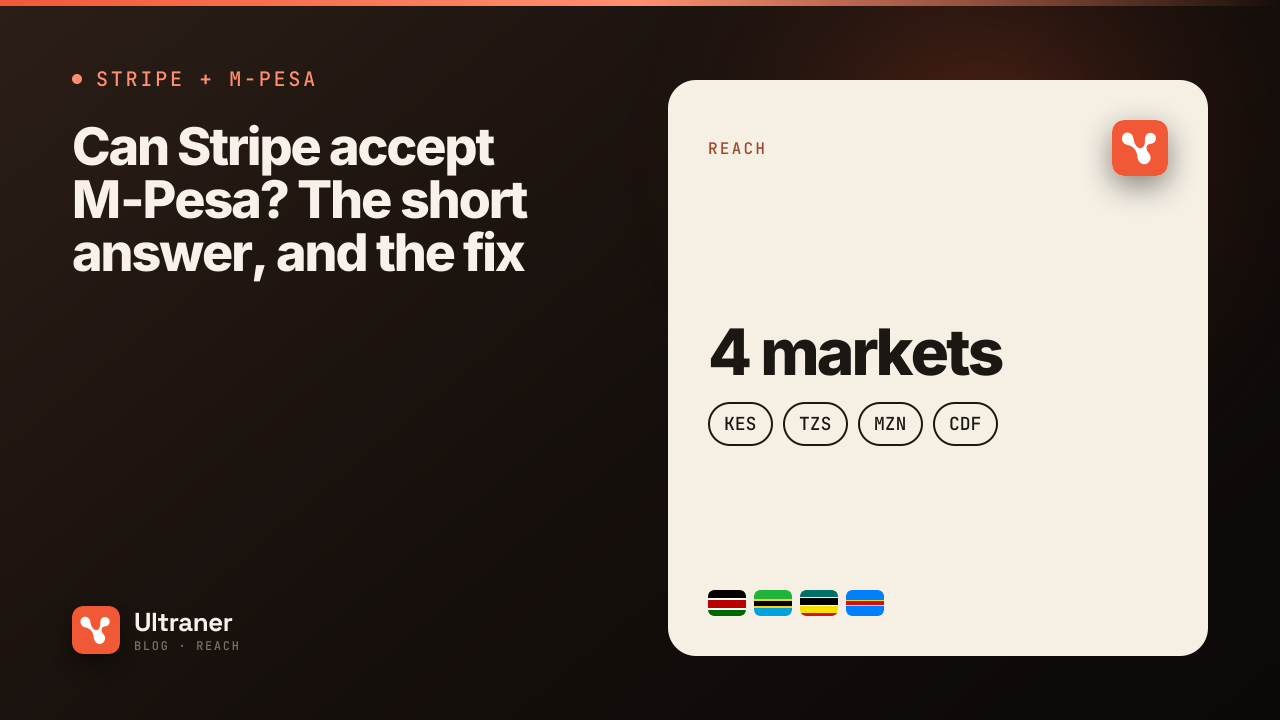
- In Tanzania, DR Congo and Mozambique, M-Pesa (Vodacom) operates in TZS, CDF and MZN respectively.
These are separate wallets on separate systems. Ultraner supports all four markets, so a customer in Dar es Salaam paying with Vodacom M-Pesa is just as reachable as one in Nairobi. But a Tanzanian wallet is not a Kenyan wallet, and the currency follows the country.
M-Pesa also exists in Ethiopia. That market is not live on Ultraner yet.
3. Getting the money to your bank abroad
Collected funds sit in your Ultraner balance in the currency they were paid in. From there you have two options.
Settle to your bank account. You add your company bank account once in the dashboard. A person reviews it before anything can be sent there (a wire cannot be recalled, so a wrong digit needs to be caught first). After that, you request a settlement and the balance goes by wire. This works in every country.
Spend it inside Africa. If you have suppliers, contractors or a team in East Africa, you can pay them from the same balance. Wallet payouts to mobile money are live in Tanzania today, and opening market by market. Wallet-to-wallet transfers inside Ultraner are free.
The settlement capability page has the detail.
What it costs
Three layers, each visible before you commit:
| Layer | Who charges | Amount |
|---|---|---|
| Collection | Ultraner | 0% |
| Network charge | The rail | Varies by market. Kenya prices in tiers, not a flat percentage. |
| Settlement to your bank | Ultraner | 3%, plus 1% for an international transfer outside the US |
The API will quote the exact network fee for a specific payment before you take it. The full schedule is on pricing.
When you settle, the KES balance converts to your currency at Ultraner's published rate. Rates are live on /fx, and every converted transaction gets its own page showing the rate applied, the fee and the net amount.
A concrete example
A language-learning app in London sells a KES 1,500 monthly plan in Kenya.
- A learner in Mombasa taps "Pay with M-Pesa", enters her number, approves the prompt. Done in under a minute, no card.
- The app's balance is credited KES 1,500, minus the tiered network charge for that amount.
- At month end, the app settles its KES balance to its UK bank account in GBP. The settlement carries 4% (3% plus 1% for a non-US transfer).
Because it is a subscription on mobile money, next month the learner gets a fresh prompt to approve. There is no stored card to charge silently, so the app's reminder copy should say "approve this month's payment on your phone".
Why not just use cards?
You should still offer cards. Ultraner processes them through Stripe, so a Kenyan customer with a Visa card can use it.
But many won't. GSMA's data shows mobile money accounts in Sub-Saharan Africa far outnumber what card penetration alone would suggest 3, and the World Bank's Findex survey has documented for years that mobile money is how a large share of adults in the region hold an account at all 2. If your checkout only takes cards, you are selling to the part of the market that looks most like home.
The checklist
Before you launch M-Pesa from abroad:
- [ ] Price in KES with a round number, not a converted dollar amount.
- [ ] Offer M-Pesa first for Kenyan numbers, card second.
- [ ] Ask for the phone number in international format so the country is unambiguous.
- [ ] Decide your settlement rhythm (weekly or monthly) so FX conversion is predictable.
- [ ] Test the whole flow in sandbox with a
uk_test_key; the docs show every method.
The Kenya page lists which Kenyan networks are live today: M-Pesa, Airtel Money and T-Kash.