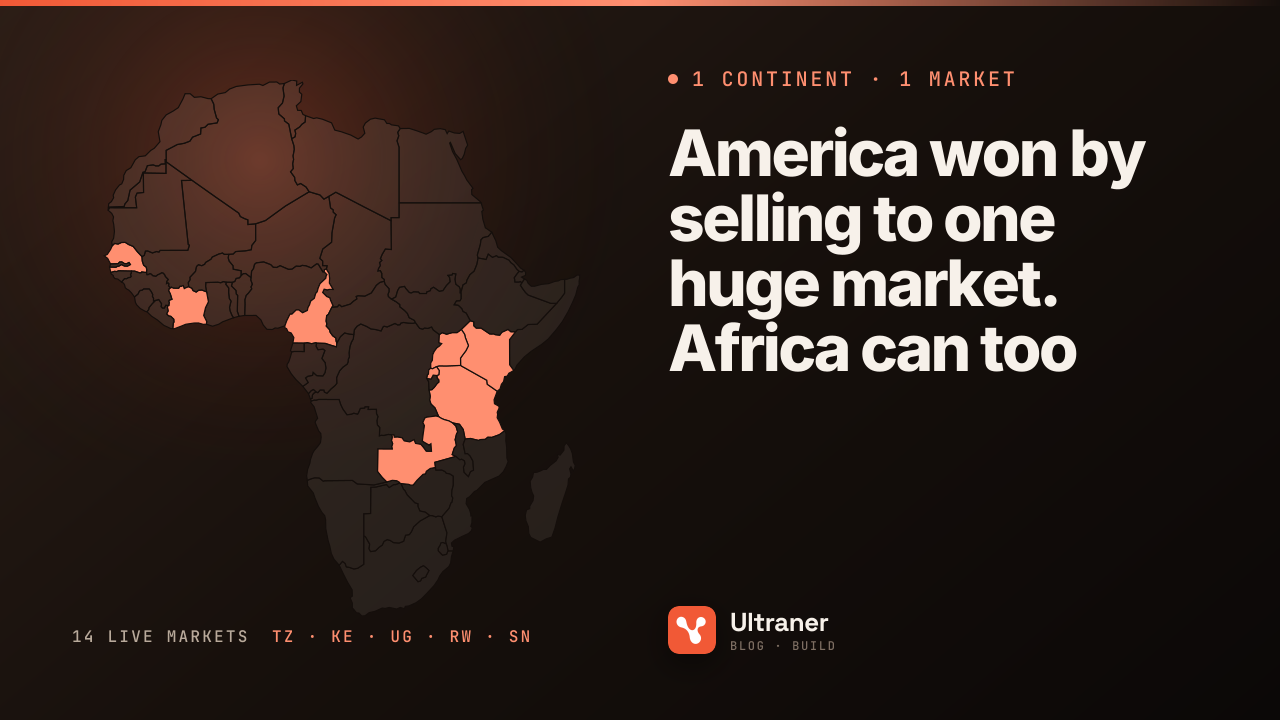

"We are launching in Africa next quarter" is a sentence that tells you a company has not looked at a payments log yet.
Nobody launches in Europe. They launch in Germany, or France, or the Netherlands, and they know that a Dutch checkout without iDEAL and a German one without bank transfer will underperform. The same companies will then put "Africa" on a slide as one box, with one payment method, and wonder why conversion in Kampala looks nothing like conversion in Lagos or Dakar.
Africa is the biggest mobile money region in the world by a wide margin. The GSMA put mobile money transaction value on the continent at around $1.4 trillion in 2025 1. That number is real and it is also misleading if you read it as one market. It is the sum of dozens of separate markets, each with its own wallets, currency, regulator and habits. Ultraner is live in fourteen of them, and no two are the same.
Count the differences
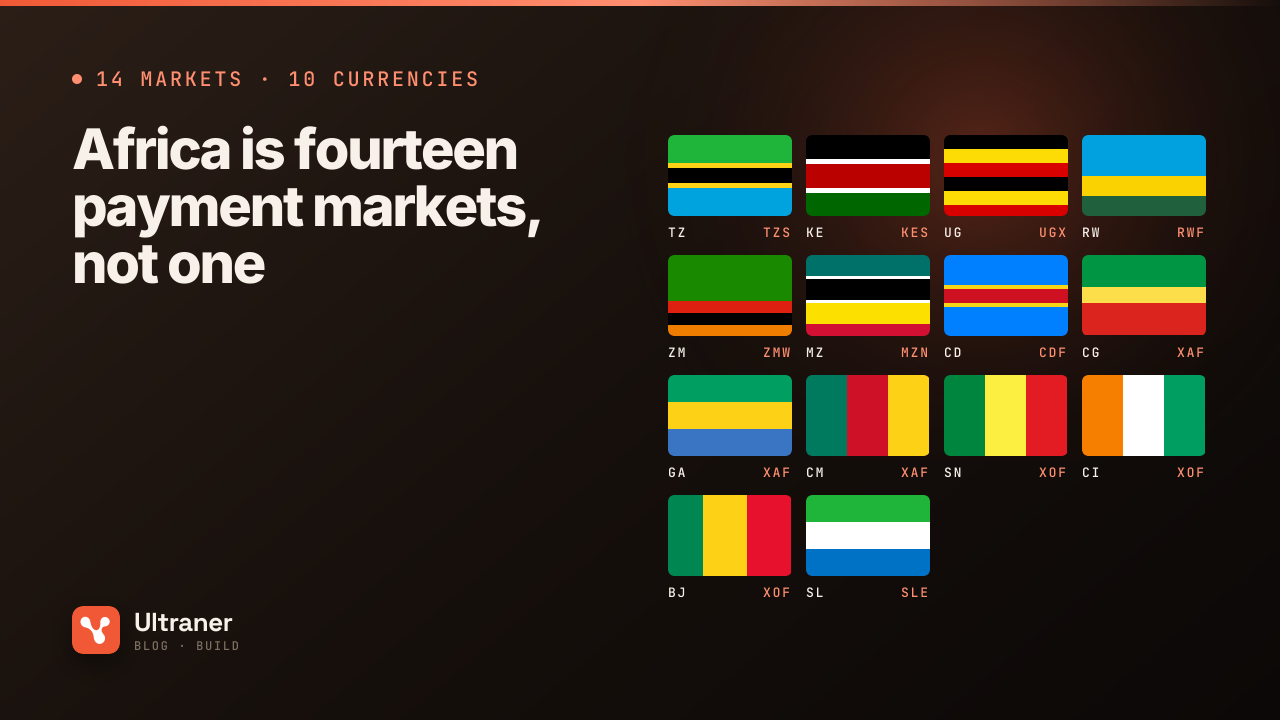
Take just the fourteen markets where Ultraner collects today: Benin, Cameroon, DR Congo, Gabon, Ivory Coast, Kenya, Mozambique, Republic of Congo, Rwanda, Senegal, Sierra Leone, Tanzania, Uganda and Zambia.
Currencies: ten. TZS, KES, UGX, RWF, ZMW, MZN, CDF, SLE, and the two CFA francs, XOF and XAF. The CFA francs are each shared across several countries, issued by two different central banks, the BCEAO in the west 3 and the BEAC in the centre 4, and they are not interchangeable.
Decimal rules: two, and they do not follow geography. Kenyan shillings, Zambian kwacha, Mozambican meticais, Congolese francs and Sierra Leonean leones carry two decimal places in an API. Tanzanian and Ugandan shillings, Rwandan francs and both CFA francs are whole numbers. Kenya and Tanzania are neighbours and fall on opposite sides of that line. Code written for one charges the other a hundred times too much or too little.
Wallet brands: more than twenty distinct ones across those fourteen countries. Some cross borders under the same name: Airtel Money, MTN MoMo, Orange Money, M-Pesa. Others are local and dominant: Wave in Senegal and Ivory Coast, Mixx by Yas and Halopesa in Tanzania, T-Kash in Kenya, Zamtel Kwacha in Zambia, e-Mola and mKesh in Mozambique, Express Union in Cameroon, Africell Money in Sierra Leone and DR Congo.
Phone number shapes: at least three lengths. Most of these markets use twelve digits including the country code. Ivory Coast uses thirteen. Benin, Gabon and Sierra Leone use eleven.
None of this is exotic. It is just the detail, and the detail is where payments live.
Same brand, different market
The most tempting shortcut is to treat a pan-African brand as one thing. "We support MTN MoMo" sounds like a single integration. It is not.
MTN MoMo in Uganda and MTN MoMo in Cameroon are separate services, run by separate local companies, regulated by separate central banks, in separate currencies, with separate fees, limits and outage patterns. The same is true of Airtel Money across its markets, and of M-Pesa, which in Kenya is Safaricom's and in Tanzania, DR Congo and Mozambique is Vodacom's. Ultraner's network pages, like MTN MoMo and Airtel Money, list the specific markets each brand is live in, because "MTN" on its own does not answer the question.
Same country, different customer
Even inside one country, "the market" splits. The World Bank's Findex data shows how differently account ownership, mobile money use and bank use are spread across African countries 2. Kenya's customers lean overwhelmingly on one wallet. Senegal's spread across several and often hold more than one. Tanzania has six wallets in our checkout and real usage across most of them. A Cameroonian diaspora buyer in Paris paying for a family purchase in Douala wants a card or PayPal, while the family member in Douala wants MTN MoMo.
A single "Africa" checkout cannot be right for all of those people at once.
What treating it as one market costs you
We see three failure patterns, repeatedly.
The card-only launch. A company launches with cards everywhere because it already has a card processor, sees low conversion, and concludes African customers do not buy online. They do. They were not offered the method they use.
The one-country assumption baked into code. A team builds for its first market, hard-codes its decimals, its phone format and its network list, and then spends the second market's launch tearing those out. We wrote about what breaks between one market and five in detail.
The payout promise that does not hold. A marketplace promises sellers mobile money payouts "across Africa" because collection works across Africa. Collection and payout are different rails. Ultraner collects in all fourteen markets, settles to your own bank in any country, and pays into mobile wallets in Tanzania today, with other markets coming one verified rail at a time. A promise that ignores that difference becomes a support queue.
What to do instead
The opposite of "launch in Africa" is not "launch nowhere". It is to launch in specific countries, on purpose, and to build the infrastructure so that each new country is cheap to add.
- Pick markets by your customers, not by the map. Where are your users already? Where are your sellers? Start there.
- Model every market as data. Currency, decimals, phone prefix and length, live networks. One row per country, read by your code.
- Use one integration that routes by country. With Ultraner, the payer's phone number picks the country and the network picks the rail. Your request shape does not change between Lusaka and Libreville.
- Localise the checkout. Language, wallet order, logos, the waiting message. French in Dakar and Douala, English in Nairobi and Lusaka, Portuguese in Maputo.
- Be precise about money out. Say where wallet payouts work, and where you settle to a bank and pay onward.
The full list of live markets, with networks and currencies for each, is on the payments directory. How Ultraner connects those markets to each other, rather than just to merchants, is the subject of Ultraner Network.
The opportunity is in the plurality
None of this is a reason to stay away. It is the reason the opportunity exists. If African payments were one market with one method, a global processor would have solved it years ago. The plurality is the moat for anyone willing to do the work, country by country. Choose your first country this week, write its row, and ship it properly.