
A youth football programme in Kampala posts a photo on a Friday evening: thirty kids, no boots, a tournament in three weeks. By Saturday morning, two hundred people have shared it. Most of them would give UGX 10,000 right now if giving took ten seconds.
Whether it does depends on what the post says underneath. "Bank details in the comments" loses most of them. "Send to this number" works, until the treasurer has to reconcile two hundred anonymous transfers into a personal phone. A proper donation link, paid by MTN MoMo or Airtel Money, with a receipt and a report, is what turns a moment of goodwill into money the programme can account for.
This is a guide for small and mid-sized organisations doing exactly that. The illustrations are hypothetical. The mechanics are real.
Why mobile money first
The World Bank's Findex shows mobile money doing much of the work of financial inclusion in East Africa, with mobile money accounts common among adults who have no bank account 1. The GSMA's reports put the region at the heart of mobile money worldwide 2. For an NGO, that means the people most likely to give small amounts locally are holding a wallet, not a card.
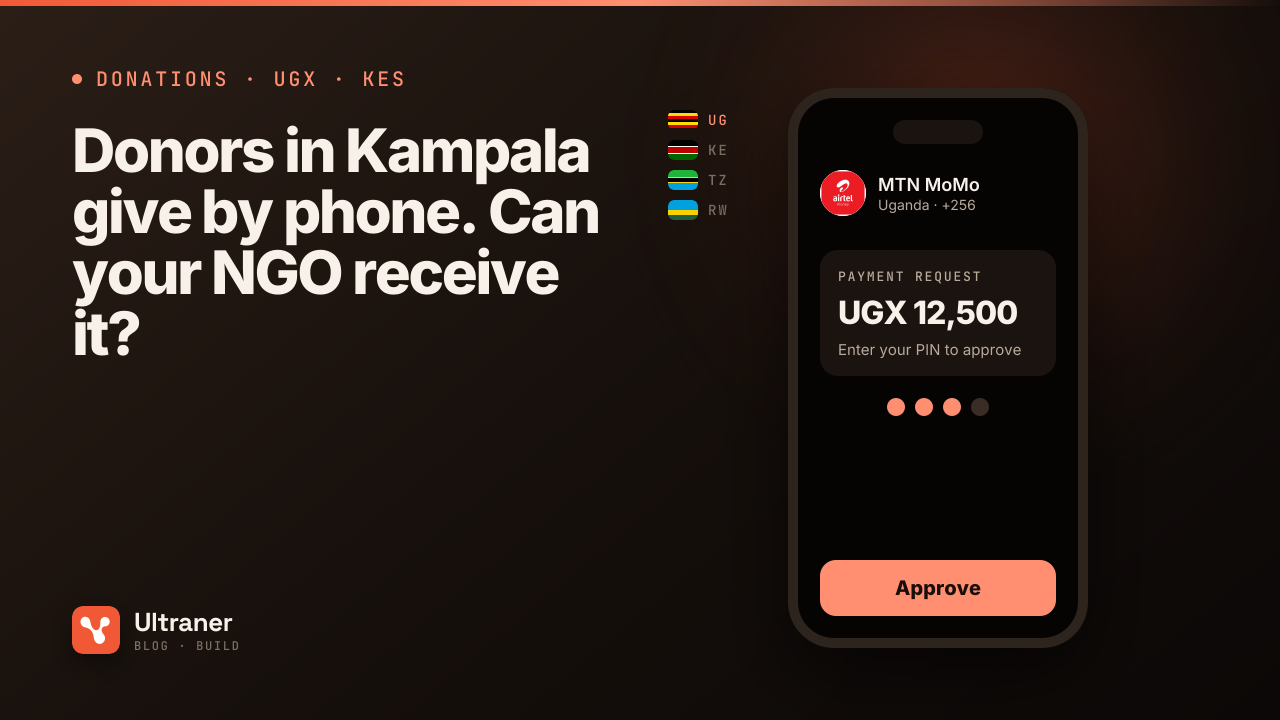
In Uganda that wallet is MTN MoMo or Airtel Money. Rwanda has the same two. In Kenya, M-Pesa (Safaricom) leads. In Tanzania, donors spread across six wallets including M-Pesa (Vodacom), Mixx by Yas and Airtel Money. A donation page that shows the right logos for the donor's country gets the gift.
Step 1: Stop using a personal number
The single most important change is the least technical. A treasurer's personal wallet is not a donation system. It mixes personal and organisational money, it produces no receipts, it gives auditors nothing to work with, and it leaves the organisation exposed if that person leaves.
Open an organisational account, verify it, and receive into the organisation's own balance. Everything below depends on that.
Step 2: Create a donation link
You do not need a developer. A payment link is a hosted page with every method the donor can use: mobile money for local donors, card (processed through Stripe) and PayPal for donors abroad. You share the link, or a QR code that opens it, anywhere people already are: WhatsApp, Facebook, the church bulletin, a banner at the match.
Two settings make it a donation page rather than a shop:
- Let the donor choose the amount, with suggested values that make sense locally. In Uganda: UGX 10,000, 20,000, 50,000. In Kenya: KES 200, 500, 1,000. UGX has no minor unit, so UGX 10,000 is just
10000; KES carries two decimals, so KES 500 is50000if you ever touch the API. - Write a specific title. "Boots for 30 players, Kampala Youth League" raises more than "Donate".
The accept donations use case walks through the setup, and the Uganda payments page shows exactly what a Ugandan donor sees.
Step 3: Offer monthly giving
One-off appeals pay for boots. Monthly donors pay for a coach. A recurring donation link lets a donor sign up once on any method:
- On card or PayPal, the charge repeats automatically each month.
- On mobile money, no African network stores credentials for a merchant to pull from, so each month the donor receives a fresh prompt to approve. That is not a weakness for a charity. It is a monthly moment of consent, and a reminder of why they give.
Every recurring donor gets a public page where they can see their history and cancel without emailing anyone. That matters for trust. A donor who knows they can stop easily is more willing to start.
Tell monthly mobile money donors what to expect: "On the 1st of each month you will get a prompt for UGX 20,000. Approve it to keep giving." Then thank them when the receipt goes out.
Step 4: Receipts and thanks
Every successful payment produces a record with an Ultraner transaction reference. Recurring charges auto-issue a receipt by email or SMS, whichever the donor gave. For one-off gifts, send your own thank-you within the hour. Speed of thanks predicts the second gift.
If donors need receipts for tax purposes in their own country, the diaspora donor in London or Toronto especially, check that your receipt carries what their tax authority requires. That is a question for your accountant, not for your payment provider.
Step 5: Reach the diaspora
For many African NGOs, the largest single gifts come from abroad: a Ugandan nurse in Manchester, a Kenyan engineer in Houston. They will not have MTN MoMo. They will have a card or PayPal.
Because the same link offers all three, you do not need a separate "international donations" page. If you want the donor to see their own currency, currency conversion shows a donor in pounds what they are giving, and the organisation is credited in its own.
Step 6: Report like you mean it
Donors, boards and funders all ask the same question: where did the money go? Your payment records can answer the first half, where it came from:
- Total raised per appeal, per day, per method.
- Number of donors, and how many are monthly.
- Average gift by country.
Export those weekly. Pair them with the second half, what you spent, and publish a short update. Organisations that report on small appeals get trusted with larger ones.
If you have a developer, a webhook on payment.success and recurring.success can update a public "raised so far" counter on your site in real time. Nothing raises money like a progress bar that is nearly full.
Step 7: Move funds to where you spend them
Donations collect in the organisation's balance. From there:
- Settle to your bank account. Settlement works to your own bank account in any country, which suits an international NGO whose finance office is in Nairobi or Geneva while giving happens in Kampala.
- Pay suppliers or volunteers to wallets. Wallet payouts are live in Tanzania today. In Uganda, Kenya and Rwanda they are not live yet, so settle to the bank and pay from there.
Check the costs on the pricing page and build them into your appeal. Donors understand fees when you are open about them. Some organisations offer donors the option to cover the fee; many donors tick it.
Regulation is yours
Charities in each country have their own registration and reporting duties, and mobile money in Uganda operates under the Bank of Uganda's payment systems framework 3. A payment provider handles the money movement. It does not register your organisation or file your returns. Make sure your board knows who does.
The Friday evening test
Before your next appeal, try it the way a donor would. Open your donation link on a cheap Android phone, on mobile data, in the evening. Give UGX 5,000 with your own wallet. Count the seconds from tapping the link to the receipt arriving. If it is under a minute and you never felt unsure what was happening, you are ready for the post that goes viral.