
The United States did not produce trillion-dollar companies because Americans are smarter. It produced them because an American startup is born selling to one enormous market.
A company in Ohio can reach about 340 million people 2 with one language, one currency, one legal system and one way to pay. It can grow to a billion dollars of revenue without ever leaving home, and only then go abroad, with scale already behind it. That is the quiet advantage behind almost every giant American company: a home market big enough to make them giant first.
An African company is born into the opposite situation. A Tanzanian startup's home market is one country. A Rwandan one, smaller still. Each African market alone is modest: fewer people than the US, a smaller share of them online 3, lower average spending power. A founder who stays inside one border is capped by that border.
But zoom out and the picture inverts.
The market most founders do not see
Africa is home to around 1.5 billion people 1, more than four times the population of the United States, and the youngest population of any continent. The African Continental Free Trade Area brings together a market the AfCFTA Secretariat describes as more than a billion people across its member states 4. Mobile money already moves well over a trillion dollars a year across the continent 5, most of it in exactly the markets where card payments never took hold.
The spending power that looks thin in one country looks very different summed across many. Ten markets of fifteen million connected consumers is a hundred and fifty million customers. That is a market on the scale of the largest countries on earth, built from pieces no single investor spreadsheet ranks highly.
The constraint has never been the size of the prize. It has been the cost of reaching it. Every border meant a new currency, new payment networks, new contracts, new phone formats and a new bank. So most African businesses stopped at the first one.
The border that matters is the payment
Of all the frictions between African markets, payments are the one that kills expansion fastest. You can translate a website in a week. You can ship a product across a border with a partner. But if a customer in Kampala cannot pay you with the wallet in their pocket, they are not your customer, no matter how good the product is.
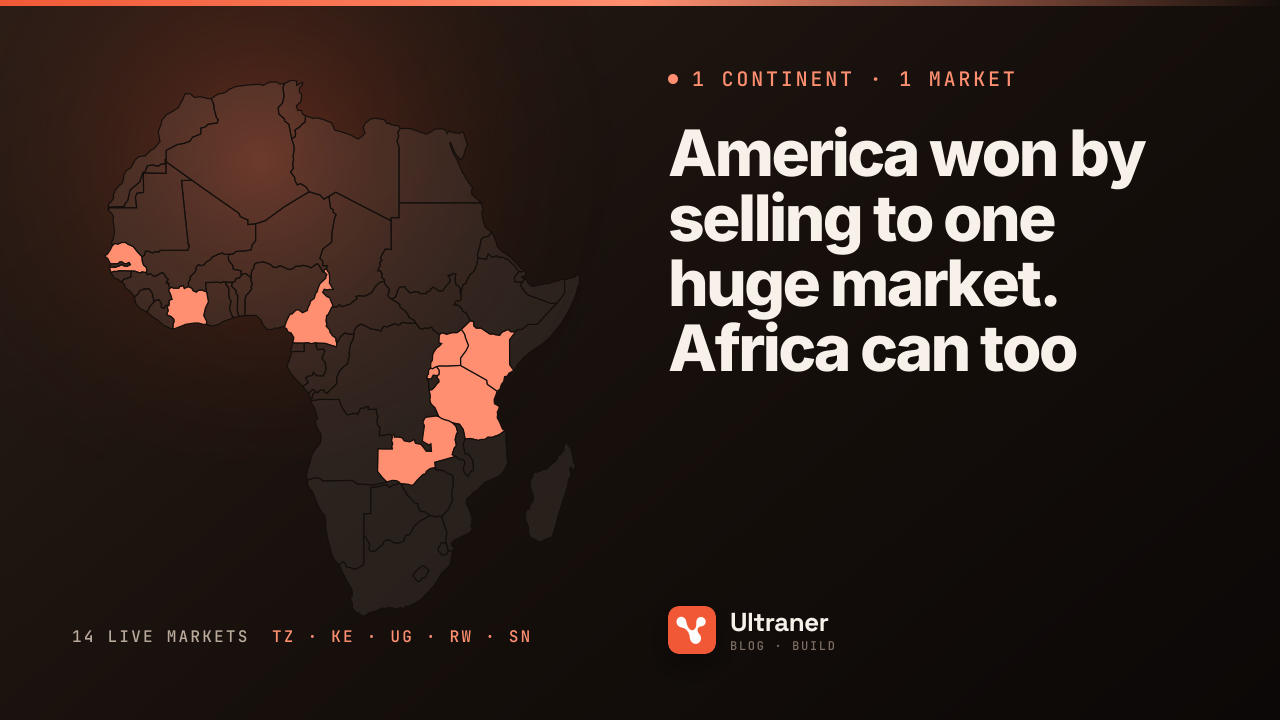
That is the part that is now solved. A business on Ultraner reaches customers in fourteen live markets through one integration: Tanzania, Kenya, Uganda, Rwanda, Zambia, Mozambique, DR Congo, Republic of Congo, Gabon, Cameroon, Senegal, Ivory Coast, Benin and Sierra Leone. Each customer pays with their own network (M-Pesa, Airtel Money, MTN MoMo, Orange Money, Wave and the rest) in their own currency. The business sees one balance and settles to its bank account wherever it banks.
For a company in any of those fourteen markets, that changes the question. It is no longer "how do we grow in our country?" but "which of the other thirteen do we open next?"
How the next giant gets built
The American playbook was: win a huge home market, then go global. The African version is: treat the continent as your home market from the start.
In practice that means a few decisions, made early:
- Price in local currency, everywhere. A customer in Dakar thinks in XOF, a customer in Nairobi in KES. Show each the price they understand. Pricing in local currency covers the details.
- Design the checkout around mobile money. The prompt on the phone is the checkout most Africans trust. Cards are a useful addition, not the foundation.
- Open markets in sequence, not all at once. Start where your product already has pull, add the next market when the first one is working, and reuse everything. The integration does not change; only the market list grows.
- Keep the money in one place. One balance across markets makes the finance work small enough that a startup can do it without a treasury team.
None of this needs a different company for each country. It needs a company that decided, on day one, that its market is the continent.
The window
The infrastructure to sell across African borders is arriving now: trade agreements, interoperable payments, connectivity reaching more people every year 3. The businesses that position themselves first will compound while the rest are still planning their second country.
The next company the world talks about the way it talks about the American giants could be built in Dar es Salaam, Kigali or Abidjan. It will not be built by selling to one country. It will be built by selling to all of them.
If your business is in one of Ultraner's fourteen live markets, the rest of the continent is one integration away. See what you can do across Africa, or start with the docs.