
The best signal that your idea is a business is a stranger paying for it.
Not a friend saying it sounds great. Not a waitlist. Money, from someone who owes you nothing. Founders know this and still put it off, usually because taking payments feels like something that happens later, after the app, after the company is registered properly, after the bank account. In much of Africa that order is backwards. Your customers already pay each other on their phones every day 1, and the tools to receive that money exist now. The earlier you ask for it, the sooner you learn what you are actually building.
This is a path from idea to paying customers, in the order that teaches you the most for the least effort.
Step 1: Sell it before you build it
Write down the thing you would sell, the price, and who it is for. Then try to sell it as it is: a service you deliver by hand, a pre-order, a first month at a founding price.
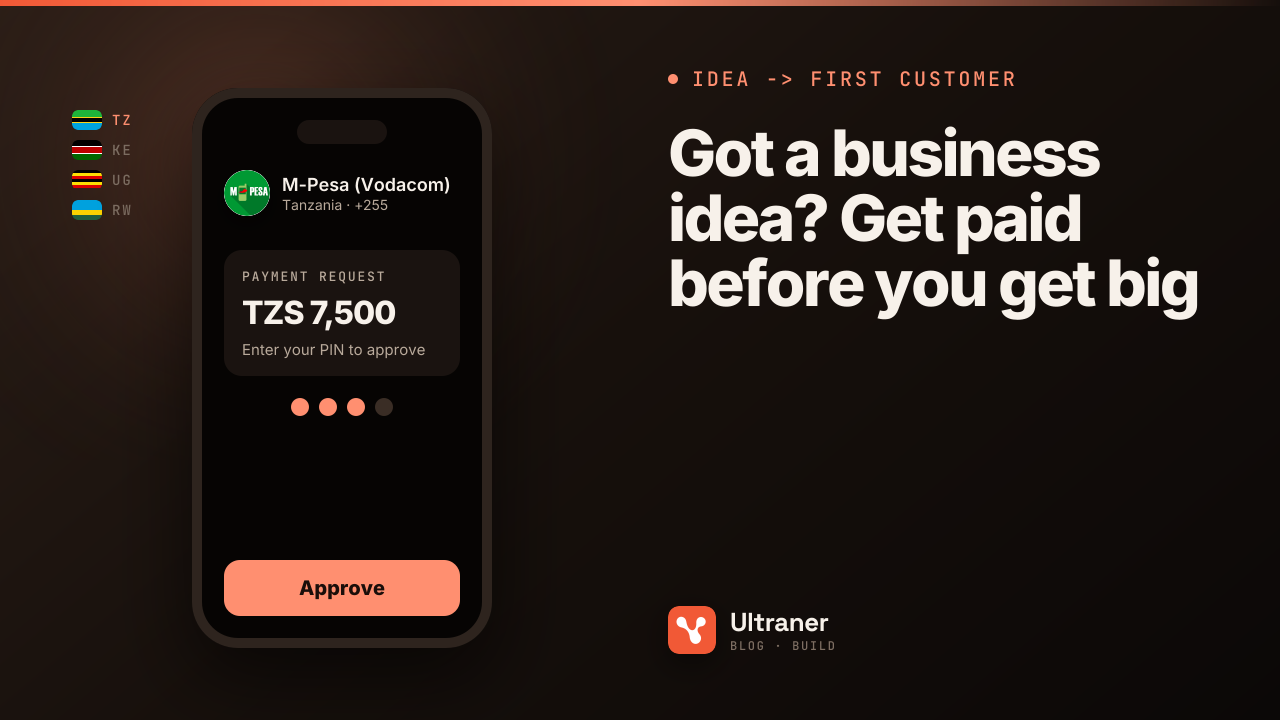
You do not need a website for this. A payment link is enough. You create it in the dashboard with a name and an amount, and send it on WhatsApp, Instagram or SMS. Your customer opens it, picks M-Pesa, Airtel Money or whichever network they use, approves the prompt on their phone, and you are paid. It works in each of the fourteen markets Ultraner covers today, from Tanzania to Kenya.
What you are measuring is simple. Out of every ten people who say they want it, how many pay? Conversations tell you what people think. Payments tell you what they do 3.
Step 2: Make the money boring
The moment the first payments arrive, keep them separate from your personal money. It sounds like accounting advice, and it is, but it is also product advice: you cannot tell whether the business works if its money is mixed with your rent.
An Ultraner business account gives you a balance that is only the business. Every payment shows who paid, how much, on which network and when, which is exactly what an investor, an accountant or a tax office will ask for later. Settling to your bank works in every country, whenever you want to move the money.
Step 3: Build only what the payments justify
Once people are paying, the first version of the product writes itself. You know what they bought, what they asked for, and what they complained about. Build that.
When it is time for a real checkout inside your product, it is one integration. A developer, or an AI assistant with the right instructions, can wire up mobile money in an afternoon; this guide shows how. Cards and PayPal come through the same integration, for the customers who have them.
A few patterns founders reach for early:
| You are building | What you need first |
|---|---|
| A service or a shop | Payment links, then a hosted checkout |
| A subscription or SaaS | Recurring billing that sends a fresh prompt each cycle |
| A marketplace | Collect from buyers, pay out to sellers, keep your cut |
| An event or a course | Ticketed payments with clear receipts |
Each of these is a capability you switch on, not a system you build. The capabilities pages show what is live and where.
Step 4: Think in markets, not in one city
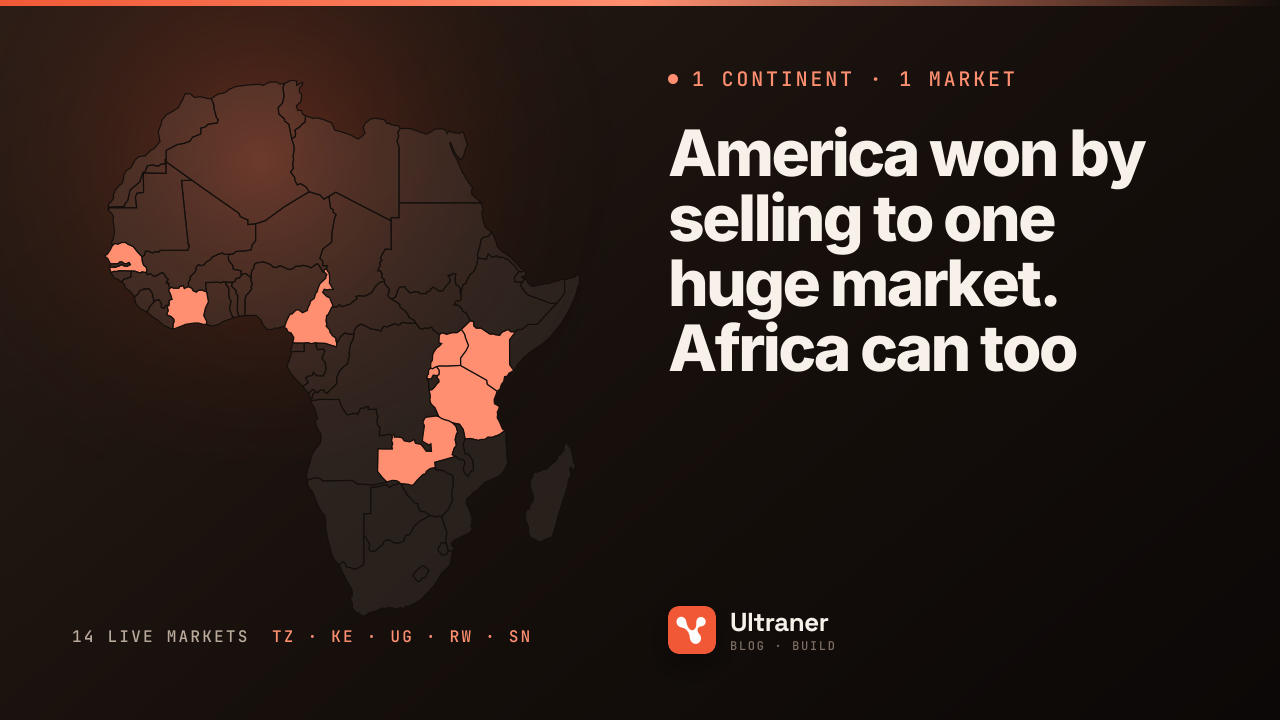
Here is the advantage most African founders underestimate. If your idea works in Dar es Salaam, it probably works in Nairobi, Kampala and Kigali too, with small changes: a different currency, different networks, different phone formats. Each country alone is a modest market. Together they are a large one.
Plan for that from the first line of code. Store amounts with their currency. Keep phone numbers in full international form. Do not hard-code a network. These are free decisions on day one and expensive ones in year two. What changes from one market to five covers the rest.
Step 5: Get verified early
Before real money flows, any payment provider needs to know who you are. With Ultraner that means verifying the business. Do it while you are still testing with payment links, so the day your product is ready to launch, nothing is waiting on paperwork.
The point
The companies that grow fastest are rarely the ones with the best first idea. They are the ones that found out quickest which idea people would pay for, and then made paying easy.
You can find out this week. Create an account, send one payment link to one potential customer, and see what happens. Everything else can wait until they say yes.