
"How do I sell to customers in Africa?" is a question with a misleading premise. Africa is 54 countries, dozens of currencies and dozens of payment networks that mostly do not talk to each other. You do not sell to Africa. You sell to Kenya, then Tanzania, then Senegal.
If you run a US startup and African users are showing up in your funnel, here are six things to understand before you spend a dollar on it.
1. Pick markets, not a continent
Start from your own data. Which countries are your sign-ups, waitlist entries or support tickets coming from? Then match that against where you can actually collect money.
Ultraner collects mobile money in 14 live markets: Benin, Cameroon, DR Congo, Gabon, Ivory Coast, Kenya, Mozambique, Republic of Congo, Rwanda, Senegal, Sierra Leone, Tanzania, Uganda and Zambia. Nigeria, Ghana and South Africa are not live yet.
That matters for planning. Many US teams assume Nigeria first because it is the largest economy and the loudest tech scene. If your traffic is Nigerian, plan around cards there for now. If it is East African or Francophone West African, you can offer the local method today.
2. The default payment method is probably not a card
Mobile money is how much of the region moves money day to day. GSMA puts mobile money transaction value in Africa at roughly $1.4 trillion in 2025 2, and the World Bank's Findex survey shows mobile money accounts doing much of the work that bank accounts do in the US 1.
The practical upshot: a card-only checkout will convert well among a small, card-carrying slice of your African audience and poorly for everyone else. It will look like weak demand. It is a missing payment method.
Your US processor is built for cards and a list of wallets 3. Ultraner adds mobile money next to cards (which it processes through Stripe) and PayPal, in one API and one hosted checkout.
3. Mobile money works differently from cards
Your engineers will want to know this before they estimate:
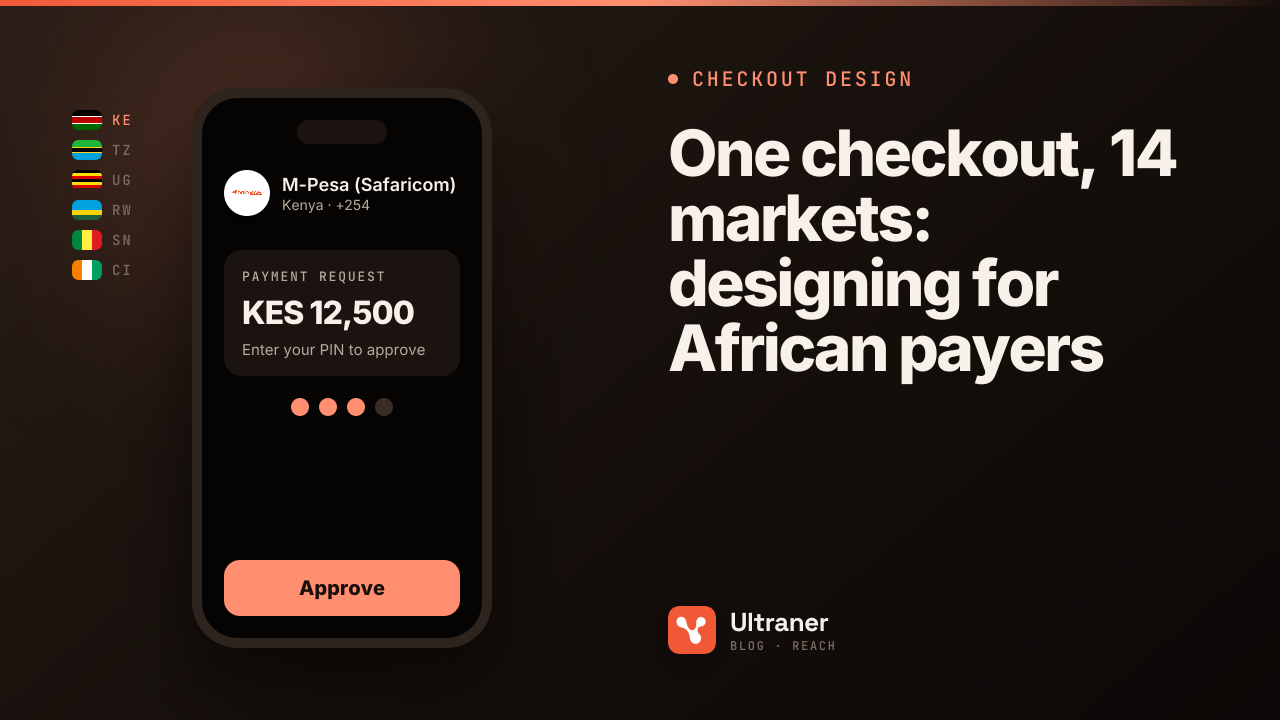
- No redirect, no card form. The customer enters a phone number. A prompt appears on their phone. They approve with a PIN. Your server gets a webhook.
- No stored credential. You cannot charge a wallet later without the customer approving again. Subscriptions on mobile money send a new prompt each period, which Ultraner schedules for you.
- The network is in the phone number. The country prefix and the operator decide the rail. Ultraner routes on the number, so a Kenyan and a Zambian number hit the same endpoint.
- Payers may pay a fee too. In some markets, Tanzania, Uganda, Zambia and Gabon among them, the customer's own network charges them on top of your price. Say so before the prompt.
The collection capability page and the docs walk through the full flow.
4. Getting paid in dollars, in your US bank
This is the question finance asks first. The answer is simple:
- Customers pay in their local currency. Your Ultraner balance holds KES, TZS, XOF and so on.
- You add your US business bank account once. A person reviews it before the first transfer.
- You request a settlement. The balance converts at Ultraner's published rate and goes to your account by wire.
Settlement to a bank account works in every country, and US accounts are the cheapest case: a flat 3% on money leaving, with no extra international transfer charge. Elsewhere it is 3% plus 1%. Collections themselves carry no Ultraner fee. Details on pricing, and every rate is public on /fx.
5. Compliance is still your job
Using a provider does not outsource your own obligations. Three to plan for:
- Sanctions screening. US persons are subject to OFAC rules regardless of where the customer is. OFAC publishes its programmes by country 4. None of Ultraner's live markets is a comprehensively sanctioned country, but individuals and entities can be listed anywhere.
- Tax. Several African countries tax digital services sold by foreign companies. Check the rules in each market you enter before you set prices, because whether your local price includes tax changes the number.
- Consumer terms. Refund and cancellation terms should be readable in the market's language. Francophone markets (Senegal, Ivory Coast, Cameroon, Benin and others) expect French.
None of these is a reason to wait. They are line items on the launch plan.
6. Pricing is a product decision, not a conversion
Charging $9.99 and letting a converter turn it into shillings produces a price that changes every week and ends in odd digits. Set a deliberate local price per market. Round it. Revisit it a few times a year.
Two shortcuts:
- In the CFA franc markets (XOF in Senegal, Ivory Coast and Benin; XAF in Cameroon, Gabon and Republic of Congo), the currency is pegged to the euro, so a price set once stays stable in dollar terms roughly as long as the euro does.
- For card buyers, Ultraner charges most currencies directly through Stripe, so the card statement shows the same number your page did.
A realistic first 90 days
Weeks 1 to 2. Pull country data. Choose two live markets with real demand. Write local prices.
Weeks 3 to 4. Integrate in sandbox with a uk_test_ key. Mobile money, card and PayPal all work there without a real phone or card. Wire up webhooks.
Weeks 5 to 6. Go live in the two markets. Put the local method first in checkout for numbers from those countries.
Weeks 7 to 12. Compare conversion against your card-only baseline. Decide on the next two markets.
The short version
- Africa is many markets. Choose two.
- Mobile money first, cards second, in those markets.
- Customers pay locally; you settle to your US bank in dollars.
- Fees: nothing to collect, 3% to bring it home to a US account.
- Compliance and tax are yours; plan them in.
Start with the country pages, for example Kenya or Tanzania, which list the live networks and currency for each market.