
A Visa card issued in Kenya works on your checkout. So why does your Kenyan conversion rate look like something is broken?
Because acceptance and behaviour are different things. Card networks made acceptance global decades ago. They did not make card the way everyone chooses to pay. In much of Africa, the default is a phone.
The numbers behind the habit
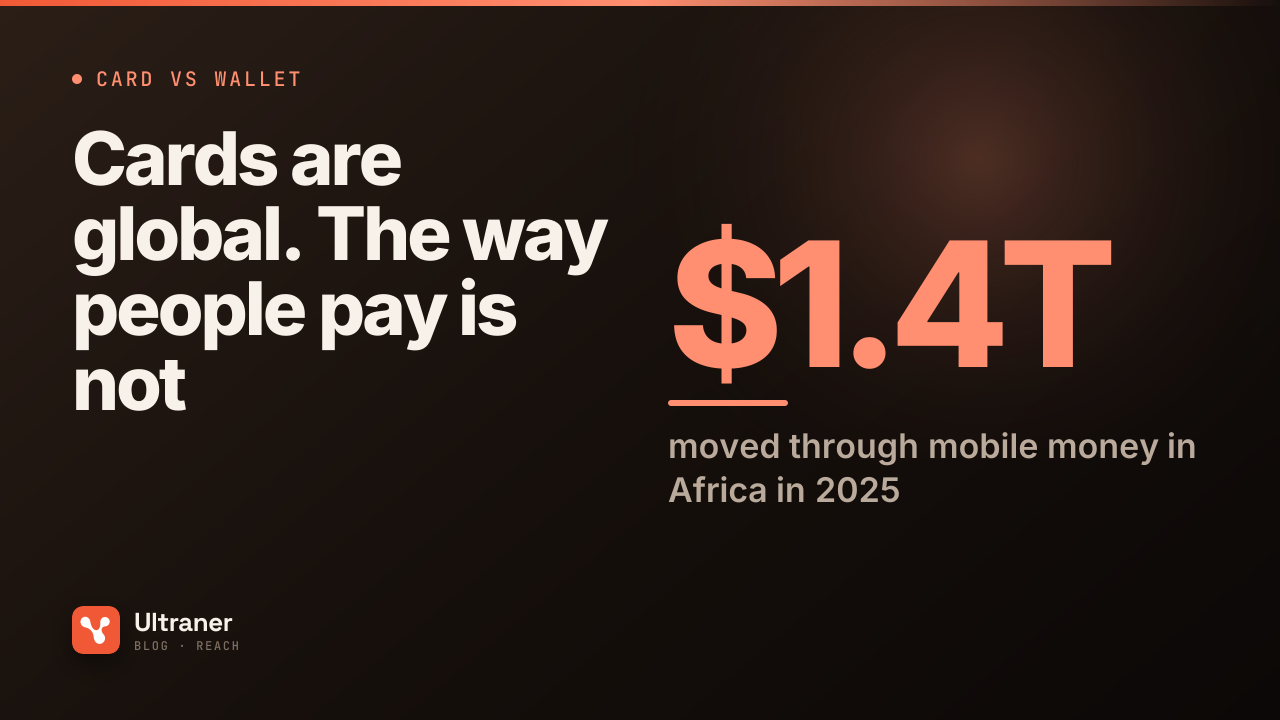
GSMA's mobile money report puts the value of mobile money transactions in Africa at roughly $1.4 trillion in 2025 1. Kenya's central bank publishes mobile payment figures monthly, and they read like the statistics of a core national payment system, because that is what they are 4.
The World Bank's Findex survey explains the other side: across Sub-Saharan Africa, many adults hold a financial account through mobile money, and for a large share it is the only account they hold 2. These customers are not outside the financial system. They are inside a different one.
So "African customers don't pay by card" is too blunt. Some do, especially for international purchases and corporate spend. But for a consumer buying a subscription, a game top-up or a course, the natural instrument is a wallet on their phone.
Why the habit holds
It is tempting to treat this as a gap that will close as card issuance grows. Look at why people prefer the wallet and it looks more durable than that.
It is the account they already use. Salary, rent, school fees, a transfer from a sibling: the money is already in the wallet. Paying from it costs nothing in mental effort.
Approval is explicit. A mobile money payment is a prompt on the customer's own phone, approved with a PIN. Nothing is stored, nothing can be charged later without asking. For a customer who has been burned by an unexpected card debit, that is a feature.
It is priced locally. A wallet holds shillings, francs or kwacha. A card on a foreign site often means a dollar price, a conversion the bank chooses, and a foreign transaction fee that only shows up on the statement.
Online card use can be harder than it looks. Cards issued for local ATM use are not always enabled for international online purchases, and declines on cross-border card-not-present transactions are a familiar story for buyers in many markets.
What a card-only checkout costs you
Checkout abandonment is high everywhere. Baymard's long-running survey of studies puts average online cart abandonment around 70 percent 3, and an unwanted or unfamiliar payment method is a recurring reason in that research. Now picture the shopper whose preferred method is absent entirely.
The cost does not show up as an error. It shows up as a cohort that signs up and never pays, or a country where paid acquisition never earns back. Teams then conclude the market "isn't ready", when the market was ready and the form was not.
Don't ask an African customer to change how they pay. Change what your checkout accepts.
What the checkout should look like instead
Three principles, in order of impact.
Lead with the local method
For a phone number in Kenya, show M-Pesa and Airtel Money first. In Senegal and Ivory Coast, Wave and Orange Money. In Uganda and Cameroon, MTN MoMo. Card stays on the page, one tap below. The per-country lists are on our pages for Kenya, Senegal, Ivory Coast and the other live markets.
Price in the customer's currency
Show KES, XOF, UGX or XAF, not a dollar figure with a footnote. If you do accept cards from these customers, Ultraner charges most currencies directly through Stripe, so the card statement matches the price on the page.
Make the approval moment obvious
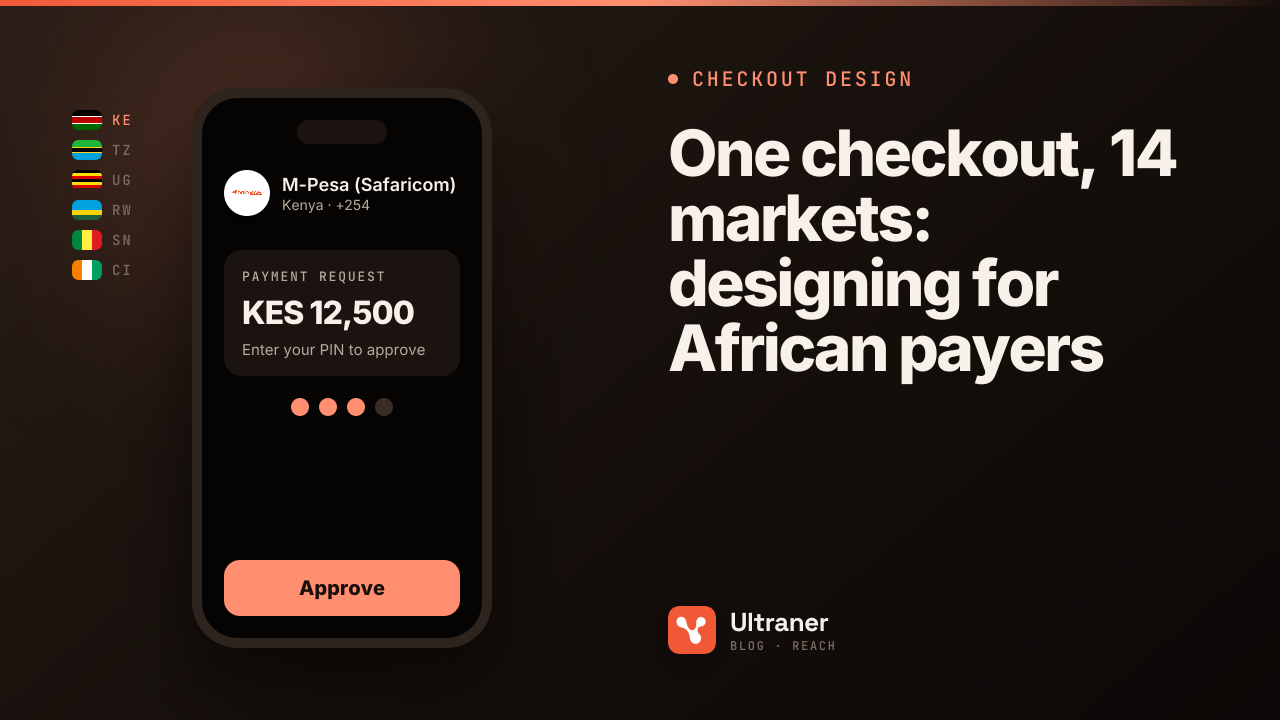
The mobile money step happens on the phone, not in the browser. Tell the customer before they tap: "You'll get a prompt on your phone. Enter your PIN to approve." Then show a waiting state that does not time out in eight seconds. People find their phones, put on glasses, check balances.
Cards still matter
None of this argues for removing cards. Ultraner processes cards through Stripe and accepts PayPal on the same checkout, because some customers in every market want them: travellers, diaspora buyers, companies paying with a corporate card, anyone buying in dollars on purpose.
The point is ordering and defaults. In London, card first and wallet second is right. In Kampala, flip it.
A short field guide
Here is how the preferred instrument tends to split by purchase type in mobile-money-first markets. Treat it as a starting hypothesis to test against your own data, not a law:
| Purchase | Likely default | Keep available |
|---|---|---|
| Consumer subscription, low ticket | Mobile money | Card |
| Game top-up, in-app purchase | Mobile money | Card |
| Online course, one-off | Mobile money | Card, PayPal |
| B2B software, team plan | Card or invoice | Mobile money |
| Travel booking, high ticket | Card | Mobile money where limits allow |
Mobile money wallets carry operator limits per transaction and per day, so very large tickets may still need a card or a bank transfer.
What to do this week
- Split your checkout conversion by country. If you have meaningful traffic from the 14 markets where Ultraner is live, look at where users drop.
- Pick one market and add its leading mobile money networks to checkout, with the local currency price.
- Run it for a month against the card-only baseline.
The collection capability explains how the prompt-and-approve flow works, and the docs show the one endpoint that handles mobile money, card and PayPal.